ZZ Plant Care Guide (2026): How to Grow a Healthy ZZ Plant Indoors
The ZZ Plant, botanically known as Zamioculcas zamiifolia, is one of the easiest indoor plants to grow. Because it requires very little attention, it is an excellent choice for beginners. In addition, its glossy green leaves add a stylish touch to homes and offices. At the same time, ZZ Plants can tolerate different indoor conditions. Therefore, they are a practical choice for busy plant owners. In this guide, you’ll learn how to care for a ZZ Plant, including watering, sunlight, soil, propagation, common problems, and helpful care tips.
Quick Plant Facts
Feature
Details
Common Name
ZZ Plant
Botanical Name
Zamioculcas zamiifolia
Family
Araceae
Plant Type
Tropical perennial houseplant
Difficulty
⭐☆☆☆☆ (Very Easy)
Sunlight
Bright indirect light to low light
Watering
Every 2-4 weeks
Soil
Well-draining potting or succulent mix
Fertilizer
Once every 2-3 months during spring and summer
Temperature
18°C–30°C
Humidity
Normal indoor humidity
Pet Safe
❌ No (Toxic to cats and dogs)
❤️ Why You’ll Love ZZ Plants
✅ Beginner- friendly
✅ Extremely low maintenance
✅ Drought-tolerance
✅ Excellent indoor decor plant
✅ Stylish modern appearance
✅ Long -lasting
✅ Slow – growing
Most importantly, ZZ Plants can tolerate periods of neglect better than many other popular houseplants. Therefore, they are especially useful for busy plant owners or beginners who are still learning a regular watering routine.
🌤️Light Requirements
ZZ Plants grow best in bright, indirect light. However, they are also well known for tolerating low-light conditions.
For faster and healthier growth, place your plant near a bright window where it receives filtered light. At the same time, protect it from strong afternoon sunlight because direct rays can scorch the leaves.
Best Light Conditions
Signs of Too Much Light
Signs of Too Little Light
For faster growth use bright indirect light
Morning sunlight will be beneficial
Avoid harsh afternoon sun
Window’s filter light
Brown Patches
Scorched leaves
Dry leaves
Slow growth
Faded leaf color
Weak growth
Long gaps between leaflets
Pro Tip: Rotate the pot every few weeks so all sides of the plant receive light evenly.
💧Watering Guide💧
❌Biggest mistakes people make is overwatering. ✅Water only when the soil is completely dry.
One of the biggest mistakes people make with ZZ Plants is overwatering. Fortunately, avoiding this problem is simple: allow the soil to dry out before watering again.
Water your ZZ Plant only when the soil is completely dry. When you do water, soak the soil thoroughly and allow excess water to drain through the bottom of the pot.
ZZ Plants store water in underground rhizomes. As a result, they can survive longer periods without water than many other houseplants.
🗓️Watering Schedule
🌅 Summer: Every 2–3 weeks
🌧️ Monsoon: Every 2–4 weeks, depending on humidity and soil
❄️ Winter: Every 3–5 weeks
Instead of following the calendar strictly, check the soil before watering. If the soil is still moist, wait a little longer.
🛑Signs of Overwatering
🛑Signs of Underwatering
🌿Yellow leaves
Wrinkled leaves
Soft, mushy base
Dry and crispy leaf tips
Root rot
Slower growth
Foul smell from soil
Dry Soil
Therefore, checking the soil before watering is more reliable than following a fixed schedule.
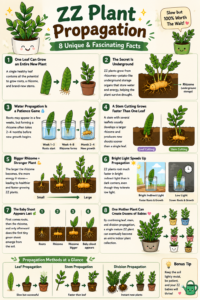
ZZ Plants can be propagated in several ways. For example, you can grow new plants from leaflets, stem cuttings, or divisions of the underground rhizomes.
However, different methods take different amounts of time. Leaflet propagation is usually slower, while division can produce a larger new plant more quickly
🌿 Did You Know?
ZZ Plants have a fascinating water-storage system. Unlike many common houseplants, they do not depend only on their leaves and roots to handle dry conditions.
Their underground rhizomes act like small storage organs. Because these rhizomes store water and nutrients, the plant can tolerate periods of dryness. Another interesting fact is that a ZZ Plant can be propagated from individual leaflets. However, this method is much slower than propagation through division or stem cuttings.
In addition, new ZZ shoots often emerge as tightly rolled structures. As they develop, these shoots gradually open into the familiar glossy foliage. Finally, the plant’s slow growth is one reason it can remain attractive indoors without frequent pruning or repotting.
🌱 Bonus: Rare & Interesting ZZ Plant Facts
🌿 Did You Know???
ZZ Plants don’t rely only on their leaves and roots for water storage. Their underground rhizomes act like small storage organs, helping the plant survive dry periods.
A ZZ Plant can be propagated from individual leaflets, although this method is much slower than propagating by division or stem cuttings.
New ZZ shoots often emerge as tightly rolled structures before gradually opening into the familiar glossy foliage.